
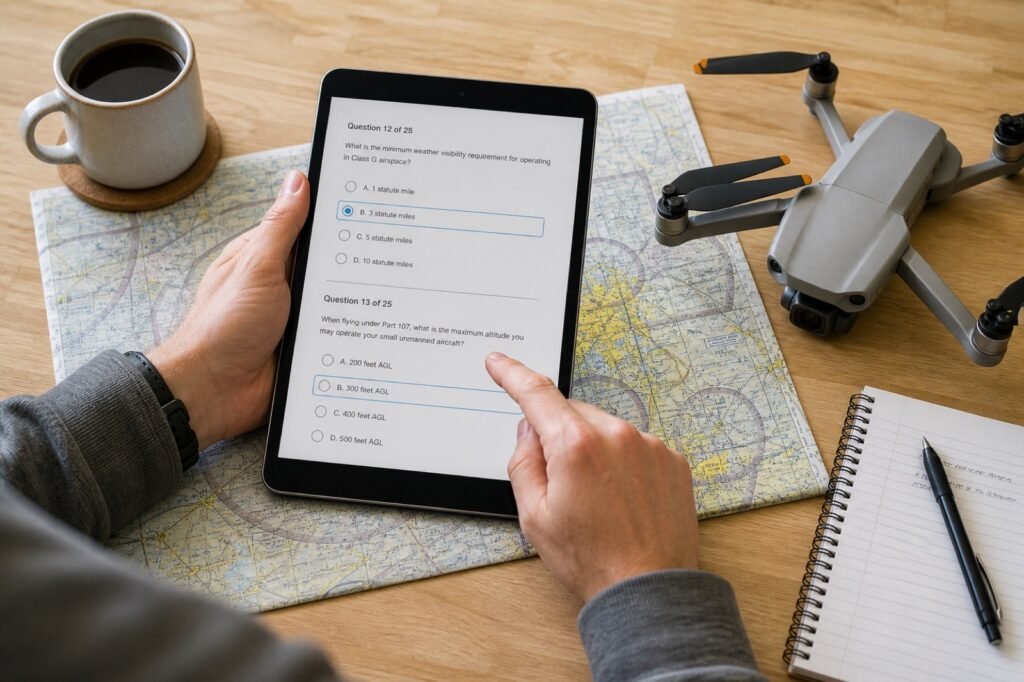
Most candidates do not fail a Part 107 practice test because they “do not know aviation.” They fail the same small patterns over and over — then bring those patterns into the FAA knowledge test. If your free sets feel stuck around 60–70%, this article is the cleanup checklist.
Skyward’s homepage practice tool is designed for short, honest reps: answer, read the explanation, tag the module, move on. Use that loop to catch the mistakes below before they become expensive ($175 per official attempt).
Mistake 1: Reading the options before the question
On a Part 107 practice test, option order is a trap. If you skim choices first, your brain starts “shopping” for a familiar phrase instead of answering the actual ask. The FAA loves stems with words like except, not, minimum, and required.
Fix
- Cover the options with your hand or scroll so only the stem is visible.
- Underline the decision verb: authorize, notify, maintain, avoid, calculate.
- Only then compare A/B/C against that verb.
Do this for one full free set. You will usually reclaim two or three “careless” misses immediately.
Mistake 2: Treating airspace as trivia instead of a go/no-go call
Airspace items show up constantly on any serious Part 107 practice test. Candidates memorize Class B/C/D labels, then still pick the wrong action when the scenario mentions a surface Class E airport, a TFR, or a LAANC ceiling.
Fix
- For every airspace miss, write one field rule: “If controlled airspace is involved, I need authorization before launch.”
- Add a second line for temporary limits: “Charts are not enough — check TFRs the day of flight.”
- Drill the same idea again the next morning on the free set.
Pair this with the Learn hub airspace primers so practice questions attach to real judgment.
Mistake 3: Skipping explanations on correct answers
Getting it right for the wrong reason is silent damage. A Part 107 practice test explanation is not optional fluff — it is how you confirm the rule you actually used.
Fix
After every question, force a 10-second review:
- What rule decided this?
- Which distractor looked tempting?
- Would I still pick the same answer if the numbers changed?
If you cannot answer those three lines, mark it as a soft miss even when the tool says Correct.
Mistake 4: Only practicing short quizzes, never a 60-question clock
Daily free sets build knowledge. They do not fully train pacing. Candidates who only do short Part 107 practice test sessions often panic when they finally see 60 questions and 120 minutes.
Fix
Once a week, run a timed Part 107 practice test 60 questions mock. Use checkpoints at question 20 and 40. After the mock, build a miss list by module and let the next free sets attack that list first.
Mistake 5: Studying randomly instead of by weak module
Random volume feels productive and wastes evenings. The best Part 107 practice test routine is boring on purpose: identify the weak column, then bias tomorrow’s study toward it.
A simple weekly scoreboard
- Monday–Friday: free Part 107 practice test set + explanation notes.
- Saturday: timed mock if you have access.
- Sunday: rewrite the week’s top five misses in plain English.
That cadence compounds faster than bingeing 200 flashcards the night before your PSI appointment.
How Skyward helps you break the loop
Start on the homepage with today’s free Part 107 practice test. Read every explanation. When accuracy plateaus, unlock full-bank volume and timed mocks. Keep returning to the free morning set as a warm-up — it resets around 09:00 America/New_York so your habit stays fresh.
Internal path for SEO and study flow: Practice → Mock exam → Learn → Blog guides.