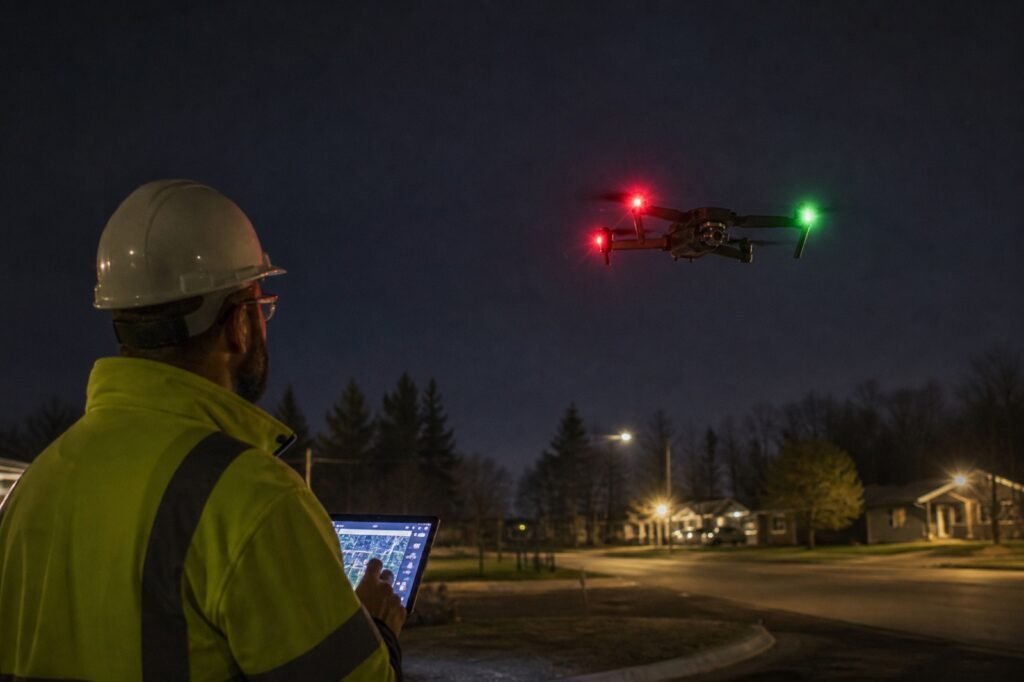
Commercial drone work does not stop at sunset. Roof inspections, utility corridors, and some mapping jobs happen in civil twilight or at night. Part 107 night operations are legal under current rules when you meet the lighting and operating requirements — and they are a regular source of Part 107 practice test misses.
The old mental model was “night = waiver.” That is outdated for many routine night flights. The current expectation is: know when night begins, equip the aircraft correctly, and still fly as PIC — not as a person with a bright strobe hoping for the best.
When “night” starts for Part 107
For practical exam purposes, night is tied to the period between the end of evening civil twilight and the beginning of morning civil twilight, as published in the Air Almanac. Civil twilight is not “when it feels dark.” Candidates miss questions because they treat dusk as a gray zone where rules do not apply.
If a stem says the sun has set and civil twilight has ended, apply night requirements. Do not invent a hobby exception.
Anti-collision lighting
For night operations, small unmanned aircraft generally must have anti-collision lighting visible for a required distance and flashing at a required rate. The light is for other aviators and people on the ground to see you — not a decorative LED for the client’s B-roll.
- Install and verify lighting before the night job, not at the launch point in the dark
- Keep VLOS; lighting does not replace the need to know where the aircraft is
- Weather minima still apply; night does not lower visibility requirements
What night does not change
Night is not a free pass on the rest of Part 107:
- Airspace authorization is still required where it would be required by day
- You still yield to manned aircraft
- Over-people / over-vehicle categories still matter if people are present
- Fatigue and illusion (black-hole approaches over water, for example) are PIC problems
A good practice-test explanation will connect lighting to PIC responsibility. A weak PDF dump will only say “need lights” and stop.
Industry use cases
Night-capable remote pilots get different jobs: after-hours construction documentation, thermal inspections when roofs have cooled, and emergency-adjacent survey work for clients who cannot shut a site during daylight. Insurers still expect you to brief lighting, abort criteria, and observer roles.
How to study night items without cramming
- On each night-related miss in a Part 107 practice test, write: “Night = lighting + all other Part 107 rules.”
- Add civil twilight to your miss list if you confuse sunset with night.
- Once a week, run a timed mock and review only operations/emergency misses.
Use the Learn hub for operations refreshers, then return to practice so the rule becomes automatic.
Continue through the exam prep blog for related operations topics.