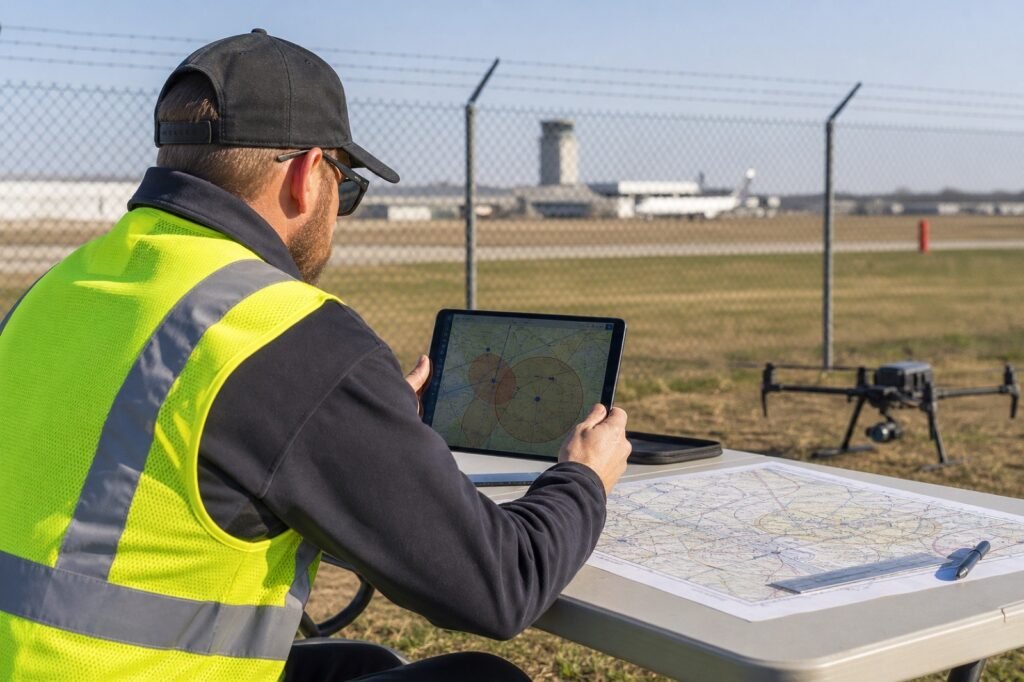
If you plan to fly commercially near many U.S. airports, you will meet LAANC — Low Altitude Authorization and Notification Capability. It is one of the most practical Part 107 skills, and it is also one of the easiest to misunderstand on a Part 107 practice test.
LAANC is not a license to ignore traffic, TFRs, or weather minima. It is a way to request ATC authorization into certain controlled airspace at or below published grids, often in near real time through an FAA-approved UAS Service Supplier app.
What LAANC is for
Under Part 107, flying in Class B, C, or D airspace — and in some surface Class E areas around airports — generally requires airspace authorization. LAANC automates a large share of those requests where a facility has published UAS facility maps.
- You request a specific location, altitude, and time window
- If the request is within the auto-approval grid, you may get near-instant authorization
- If it is above the grid or otherwise non-auto, it may need further FAA processing (for example through DroneZone)
What authorization does not do
This is the exam trap and the field trap:
- Authorization to 200 feet does not let you climb to 400 feet in that grid
- LAANC does not cancel a TFR, stadium restriction, or NOTAM
- You still need VLOS, see-and-avoid, and Part 107 weather minima
- A visual observer does not replace missing authorization
When a practice question offers “just launch because you can see the airport,” that is almost never the professional answer.
How this shows up on the knowledge test
Stems rarely say “LAANC” in casual language. They say “Class D surface area,” “within 4 NM of a towered airport,” or “ATC authorization required.” Your job is to pick the option that gets authorization before takeoff, not after someone complains.
A field-to-exam translation
- Identify airspace class from the scenario or chart cue.
- Ask whether authorization is required.
- If yes, the correct answer is almost always “obtain authorization first.”
- Then apply operating limits inside that authorization.
Commercial workflow that actually gets jobs done
Serious operators treat airspace like a preflight item, not an afterthought:
- Check sectional / UAS facility maps and current TFRs.
- Request LAANC (or other authorization) for the planned altitude.
- Brief the crew on the approved ceiling and abort points.
- Log the authorization reference with the job packet for the client and insurer.
That last step matters. GCs and public agencies increasingly want proof you were authorized, not just that you “usually fly there.”
How to drill this on Skyward
Use the homepage free Part 107 practice test and tag every airspace miss. Rewrite the rule in one line. When those misses shrink, prove it on a timed 60-question mock. The Learn hub airspace primers help the chart side of the same skill.
More study paths: blog cluster.