
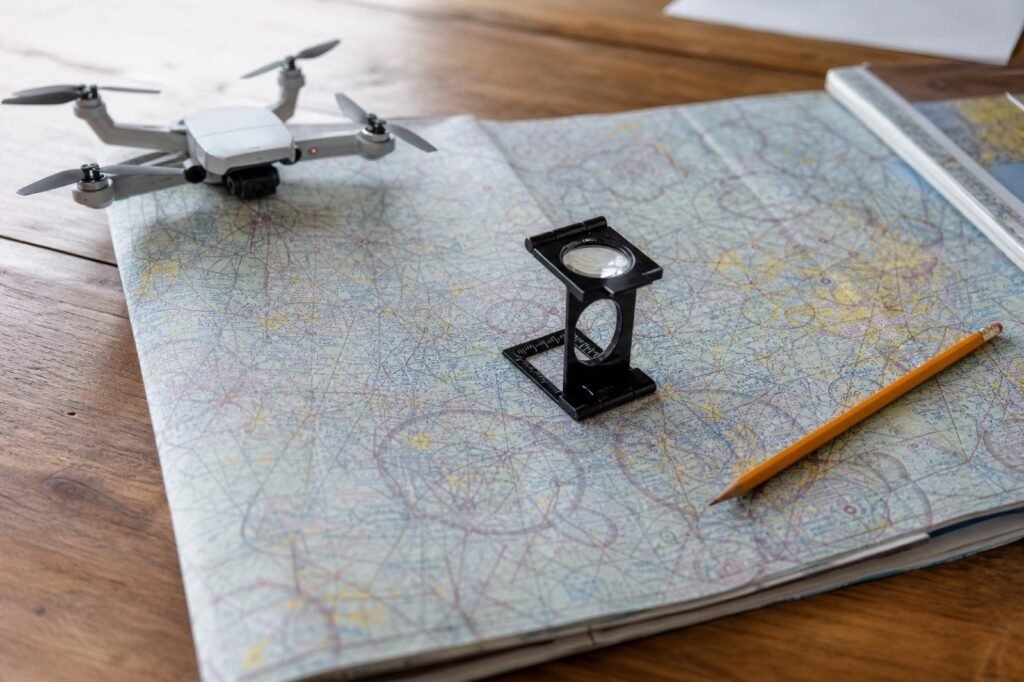
Many Part 107 practice test misses are really chart-literacy misses. The question looks like a regulation item, but the deciding skill is reading what the chart is telling you about airspace, airports, and operating constraints.
Remote pilots who only memorize flashcards freeze when a stem mentions a surface area, a Mode C veil, or a frequency. Train chart habits on purpose and your practice scores jump for more than one module.
What chart skills a Part 107 practice test is really testing
- Whether airspace requires authorization before you launch
- How close you are to an airport traffic environment
- Whether temporary restrictions could override a “normal” day
- Whether your planned altitude conflicts with local constraints
That is operational judgment — the same judgment clients expect on a paid mapping or inspection job.
Skill 1: Spot controlled vs uncontrolled airspace quickly
On practice questions, slow down when you see Class B, C, D, or surface Class E language. Ask: “Do I need ATC authorization here?” If yes, the correct option usually centers on authorization, not on hoping visual observers fix the paperwork problem.
Use a free Part 107 practice test session to tag every airspace miss. Then open the Learn primers and rewrite one sentence you will remember on exam day.
Skill 2: Airport awareness without overthinking
Airport-related stems often combine chart reading with communications and right-of-way ideas. You do not need to become an airline dispatcher. You do need to respect traffic patterns, CTAF context when relevant, and the fact that manned aircraft have priority.
Practice drill
- On each airport question, identify the hazard first (traffic, airspace, communications).
- Eliminate options that ignore authorization or see-and-avoid basics.
- Choose the option that keeps the remote PIC responsible and conservative.
Skill 3: Treat TFRs and NOTAMs as chart overlays
A sectional is a baseline. Temporary Flight Restrictions can appear after you studied. Good Part 107 practice test explanations often remind you to verify current restrictions before flight. Translate that into a habit: chart + current briefing, not chart alone.
Skill 4: Connect weather minima to the map in your head
Visibility and cloud clearance questions feel abstract until you imagine the operating area. If visibility is below typical Part 107 minima, the chart does not save you — you simply do not launch. Practice tests that mix weather and operations are training that combined judgment.
A 7-day chart-focused practice plan
- Days 1–2: Free Part 107 practice test sets; write an airspace rule for every miss.
- Days 3–4: Revisit Learn articles and redraw a simple airspace sketch from memory.
- Day 5: Another free set, aiming for fewer repeated airspace traps.
- Day 6: Timed 60-question mock if unlocked; review only chart-related misses.
- Day 7: Teach-back — explain three chart decisions out loud without notes.
How to use Skyward for chart transfer
Start on the homepage free Part 107 practice test. Read explanations even when correct. When airspace and airport items stabilize, prove it with a timed mock. Keep the cluster path tight so Google and your study brain see one coherent hub: practice tool, mock exam, Learn, and blog.
Common chart traps on practice tests
- Assuming Class G always means “no paperwork ever” near airports that actually need authorization
- Ignoring temporary restrictions because the paper chart looked quiet
- Picking an altitude that is legal in open areas but wrong inside a constrained surface area
- Forgetting that see-and-avoid and right-of-way still apply even when authorization is approved
When you miss one of these on a Part 107 practice test, convert it into a one-line operating rule and keep that rule next to your miss list. Exam recall improves when rules sound like field decisions.
Related reading lives on the Part 107 exam prep blog. The goal is not prettier notes — it is fewer expensive retakes and safer commercial flights.